Before the Kodak Brownie, photography was a specialist pursuit. It required heavy equipment, chemical knowledge, and a level of commitment that put it beyond most ordinary people. After the Brownie, photography was something families did on holiday, something children did in the garden, something that captured the texture of ordinary life rather than just its formal occasions. Here's the story of the camera that changed all of that.
The problem before the Brownie
By the 1890s, the photographic industry had been growing for several decades, but it had not yet made photography accessible to ordinary people. Cameras were large, expensive, and required the user to understand something about photographic chemistry. Developing images meant either having your own darkroom or sending film away and waiting. The process was too involved for anyone who didn't have a specific interest in it.
George Eastman, the founder of Kodak, had already made significant progress towards simpler photography with the introduction of roll film in the 1880s and a range of cameras that required less technical knowledge than the alternatives. But even these cameras were expensive and required a degree of commitment. What Eastman wanted was a camera that anyone could use, that was cheap enough to be genuinely mass market, and that would introduce a generation of new photographers to the habit of capturing moments.
The Brownie arrives: 1900
The first Kodak Brownie was launched in February 1900, priced at one dollar in the United States, or five shillings in the United Kingdom. Both prices were deliberately set at a level that was accessible to working and middle-class families rather than just the affluent. The camera was small, simple to use, and designed around a key principle: the user didn't need to understand how it worked, only what to point it at.
The name came from the popular Brownie characters created by illustrator Palmer Cox, which appeared in children's magazines from the 1880s onwards. Kodak initially marketed the Brownie as a camera for children, but adults adopted it immediately and enthusiastically. Sales in the first year exceeded 150,000 units.
What the Brownie did to British life
The Brownie arrived at exactly the right moment in British social history. The late Victorian and Edwardian eras were a period of growing leisure time and expanding holiday culture, with the railway making the British coast and countryside accessible to millions of people who had never previously had the opportunity to travel for pleasure. The Brownie gave those people a way to bring something back.
The result was the British family photo album. Collections of images of seaside trips, garden parties, days out, and family occasions that recorded ordinary life in a way that had never been possible before. These photographs have an immediacy and informality that formal portrait photography from the same period lacks. They look like records of actual moments rather than constructed performances, which of course is exactly what they are.
The camera that kept evolving
Kodak continued producing Brownie cameras in various forms for more than seventy years after the original launch. The design evolved considerably, from the simple cardboard box of 1900 through Bakelite versions in the 1930s to more sophisticated models in the postwar decades. But the underlying philosophy remained constant: simplicity, accessibility, and the democratisation of the photographic moment.
The Brownie cameras of the 1950s and 1960s are the ones most familiar to anyone who has rummaged through a grandparent's attic. Compact, solid, slightly formal in their proportions but thoroughly practical in their design. These are the cameras that captured the Britain of the postwar boom, the holiday camps and new towns and growing suburban gardens that characterised the era.
Why it still resonates
The Brownie has an afterlife in contemporary culture that speaks to something real about its place in British memory. Vintage cameras generally, and the Brownie specifically, have become objects of nostalgic affection that sits apart from their actual photographic function. They represent a particular relationship to moments and memory that the smartphone era has changed beyond recognition.
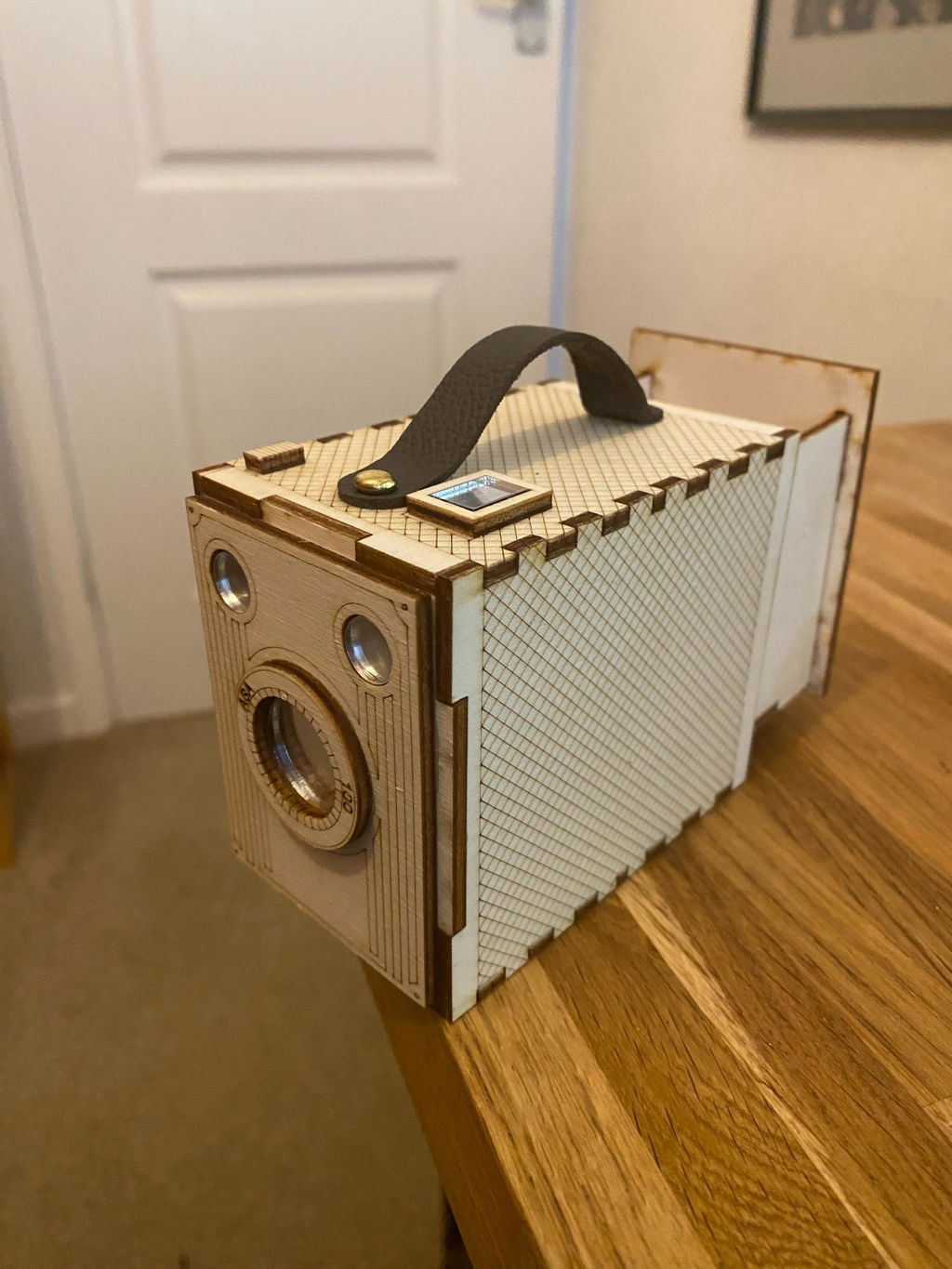
Curious Rabbit makes a laser-cut Brownie Camera kit as a miniature tribute to this history. Built from sustainably sourced wood in Wales, it captures the solid rectangular proportions of the classic Brownie in a piece that displays beautifully on a shelf or desk. Also available ready-made for anyone who wants the finished object without the build. For anyone who grew up with a Brownie on the mantelpiece, or who finds the camera beautiful simply as an object, it's a quietly pleasing piece to have around.
Curious Rabbit makes laser-cut wooden gifts and model kits, designed and made in Wales.